
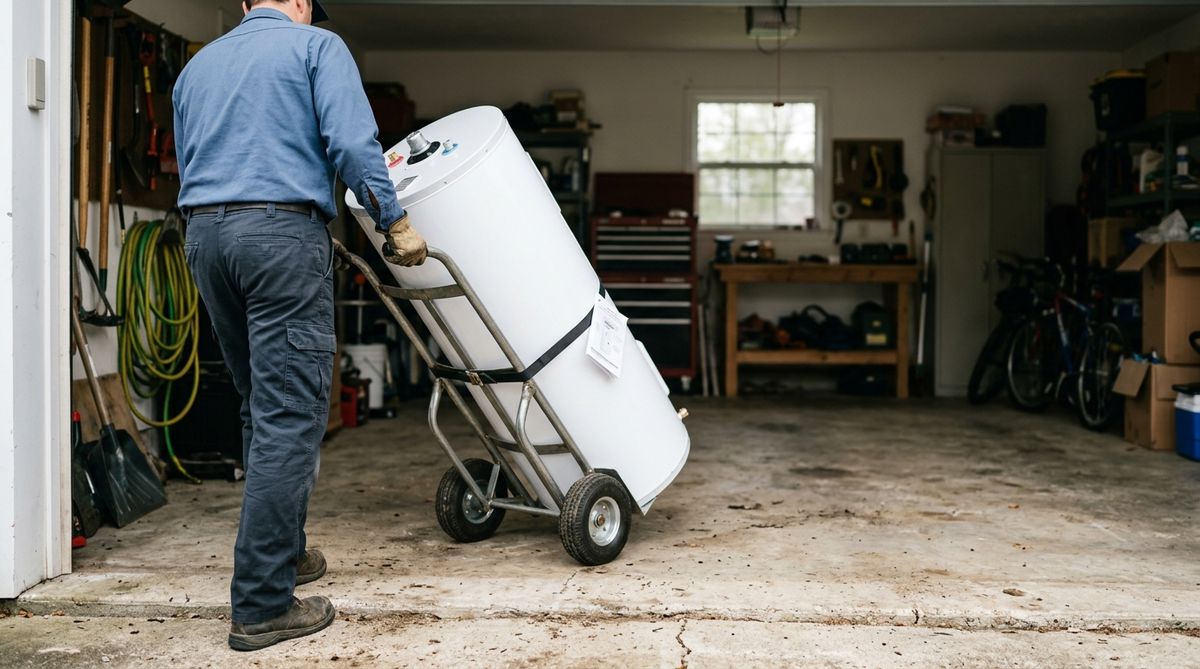
Whether to repair or replace comes down to three things together: the unit’s age against its typical service life, the repair cost as a share of a new unit’s price, and whether the fault is a simple part or a sign the tank itself is failing. No single factor decides it alone.

Likely Causes, Ranked
- Age vs. typical service life
Tank units: 8–12 years. Tankless: 15–20 years. A failure well within that window usually favors repair; well past it favors replacement. - Repair cost as a share of replacement cost
A repair under roughly 25–30% of a new installed unit’s cost is usually worth doing; above that, replacement often makes more financial sense. - What’s actually failing
A thermocouple, element, or flame rod is a repair. A leaking tank body, a hard-tripped ECO on an old unit, or a cracked heat exchanger is a replacement.
Step-by-Step Diagnosis
- DIY SAFE
Find your unit’s age
Use our serial-number age decoder if you don’t know it offhand. - DIY SAFE
Get an actual repair quote, not a guess
Compare it against typical installed-replacement costs for your unit type. - DIY WITH CAUTION
Identify exactly what’s failing
A component failure (element, thermocouple, flame rod, igniter) usually means repair. A leak from the tank body itself, or a heat exchanger fault, means replace. - DIY SAFE
Factor in efficiency gains if the unit is old
A 12+ year-old tank replaced with a modern unit (or a heat pump water heater) can meaningfully cut operating cost — sometimes enough to offset part of the replacement cost over a few years. - DIY WITH CAUTION
When in doubt on an older unit with a costly repair
Lean toward replacement — a second failure on an old unit shortly after a repair is a common and frustrating pattern.
FAQ
How much does it cost for a water heater replacement?
Installed cost varies significantly by unit type (tank, tankless, heat pump) and local labor rates — see our dedicated cost pages for each type.
Is it worth repairing a 10-year-old water heater?
Depends on the specific repair cost and fault — a cheap part swap can still make sense; a major repair on a unit already near end-of-life usually doesn’t.
What is the first thing to check when there is no hot water?
Before deciding repair vs. replace, rule out the simple stuff first — see our water heater not heating guide.
Written by HotWater Decoded — water heater repair specialists. Technically reviewed by a licensed technician on our team.
- Standard repair-vs-replace decision framework consistent with cost-guide and manufacturer service-life documentation
Home · About · Contact ·
Privacy Policy · Terms & Conditions ·
Disclaimer · Editorial Policy
© 2026 HotWater Decoded. All rights reserved.